PropTech Startup Jones Raises $2.8M Seed Round

We are happy to announce a $2.8 million seed round led by Hetz Ventures alongside JLL Spark, MetaProp Ventures, GroundUp Ventures and 500 Startups.

We help real estate owners, managers and builders tackle the recurring headache of liability insurance that arises when hiring trade contractors. By combining Software-as-a-Service tools and pay-as-you-go insurance products, we deliver a quick and affordable solution for trade contractors to comply with enterprise insurance needs.

With Jones, trade contractors can use their smartphone to instantly obtain a certificate of insurance (COI) that complies with requirements and have it approved by the enterprise, all within minutes. For contractors that already have insurance, we automate the insurance compliance cycle making it easy to approve COIs without the back-and-forth hassle between enterprises and agents. That means owners, tenants and general contractors can easily hire any qualified vendor while managers and builders can reduce their administrative overhead by up to 25%.

“We were thrilled to make Jones one of the first investments from our new JLL Spark Global Venture Fund. The Jones product immediately resonated with challenges we had been hearing from the field and are excited to bring Jones to JLL and to our clients. We are already piloting their solution in buildings we manage and the initial reception has been extremely positive,“ said Yishai Lerner, co-CEO of JLL Spark.

Liability insurance is an obstacle that runs deep in the value chain in the real estate and construction verticals. While enterprises typically transfer risk downstream, this causes an unintended market failure as contractors, subcontractors and their subcontractors don’t bid for jobs because liability insurance is cost prohibitive.

“Jones is rewriting the rules of construction insurance. Rather than simply using traditional parameters to assess the risk, the company’s data-driven approach picks up on small signals and inefficiencies to revolutionize an industry that hasn’t changed in decades. We were instantly attracted by the team, its fresh thinking and the long term vision of becoming the construction go-to-insurance provider,” said Judah Taub, Managing Partner of Hetz Ventures.

We are currently in beta with a handful of large construction and real estate players including ARCO Construction and JLL. We plan to use the funds to launch our first product, a flexible duration general liability insurance policy this fall in partnership with Chubb Insurance and a handful of marquee distribution partners in the construction and real estate industries. We are currently licensed in 12 states and have plans to be in 30 states by the end of 2018.

“Chubb’s partnership with Jones further reinforces our commitment to challenging the one-size-fits-all insurance product model and providing innovative, digital solutions to meet our customers’ evolving needs,” said Casey Campbell, SVP, Digital North America Commercial Lines.

“We’re thrilled to team up with a group of industry focused investors. We know that transforming our industry takes real distribution power. We’re glad to have partners on board that share the vision,” said Omri Stern, CEO and Co-founder of Jones.

About Jones

We are an insurance platform helping property managers and construction companies to kill the headache of insurance compliance. We provide an easy, automated insurance checkup and offer pay-as-you-go liability insurance enabling vendors to bid for any job.

About Hetz Ventures

Hetz Ventures is a $55M UK-based fund, backed by some of Europe’s most successful and best-connected investors. The value the fund adds centers on its unique network with major international companies, providing the ability to validate a company’s proposition and quickly accelerate a company’s business. The fund is focusing on Seed and Series A investments across various sectors including Fintech, Enterprise IT, Retail and Construction. Hetz Ventures is constantly seeking exceptional Israeli entrepreneurs and teams building deep and defensible technologies or disruptive business models. Go to hetz.vc for more info.

Contact Person

Nick Citron
Account Manager
nick@getjones.com
Green Building – What is it and who cares?

Living Building

It’s construction that protects, benefits or at least doesn’t harm the environment and you should. Now hang on, I’m not being preachy. Even if you’re not an “environmentally conscientious” person, I assume, as a businessperson, that you would like to turn a profit? Well, with the green building trend on the rise, your ability to apply it to your field could help you win contracts and grow your business.

The Green Trend

So what exactly are we talking about? Eco-friendly construction is about building in a more sustainable way, from reducing waste on worksites to using sustainable materials to designing buildings that will use less energy day-to-day. As environmentalism grows more prominent, more and more clients are looking for contractors that specialize in or can provide eco-friendly and environmentally sustainable solutions to their construction needs. So we wanted to go over a few of them that you may encounter.

Keep an eye out…

Here are a few of the many trends that you should consider investing your efforts in integrating into your business:

Solar energy

An oldie, but a goodie. Solar energy has been developing for a while now, but in the past five years usage has quintupled in the United States. The cells are becoming cheaper and more efficient, so you need fewer of them to power the same thing. On top of that, last year’s tax bill preserved tax credits for solar power, so you can save money by using them. Many corporations and over 150 American cities have committed to converting entirely to clean energy, which means lots of new construction and renovations with this in mind. Many states encourage construction that has energy efficiency in mind; check your state’s standards and potential rewards for integrating solar and other renewable energy sources into your work.

Resiliency

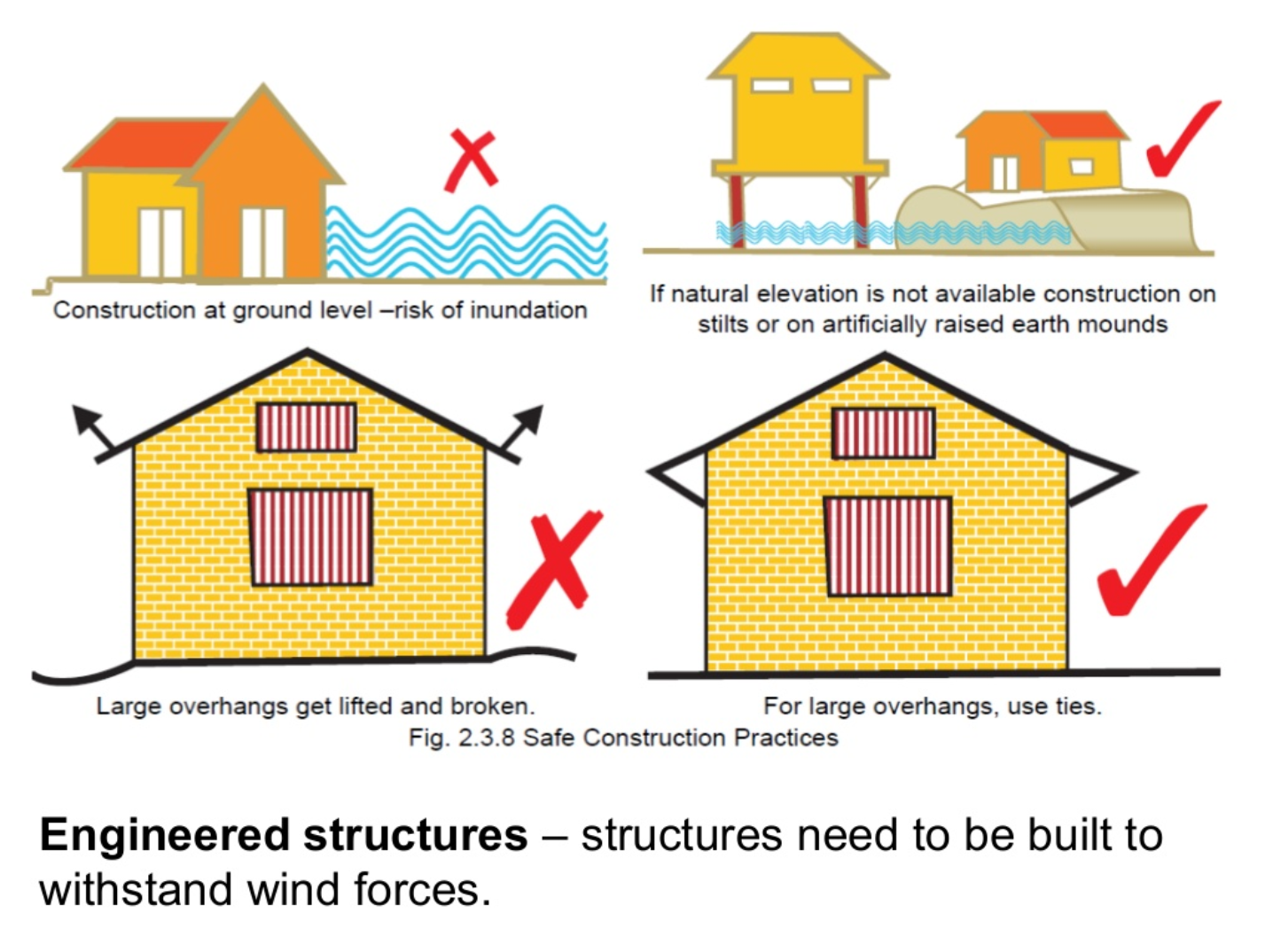
Another growing concern in building is weather resistance. As we build more, higher and closer to the coasts, our buildings are more vulnerable to increasingly violent weather and natural disasters. Hurricanes, earthquakes and tsunamis are responsible for massive amounts of destruction each year. 2017 was the costliest year on record across the United States in terms of costs from extreme weather and natural disasters.

Examples of safe building practices (Courtesy of SlideShare)

The U.S. Green Building Council has adopted the RELi rating system that assesses, rates and certifies buildings based on their weather resilience, to help you build in a more resilient way. In particularly susceptible areas (California for earthquakes and wildfires, Florida for hurricanes, etc.), demand for resilient building is almost universal. Contractors that can’t provide it are going to fall behind. According to Vox, property owners have recently taken a financial hit in the real estate market that is expected to reach $400 billion. FEMA reports that every dollar spent on resiliency saves four dollars in recovery, so even a $100 billion is worth investing your time in, eh?

Internet of Things

Setting aside the silly name, the “Internet of Things” (IoT) is the term for all of the different stuff that interacts with and receives information from its environment. Think Amazon Echo or AC that turns on if it knows you’re on your way and it’s hot outside. It’s sort of a precursor to artificial intelligence. Basically, the IoT can be utilized to automatically manage energy efficiency of a home, skyscraper or even of a massive complex.

Quality building maintenance helps these spaces to operate at optimum energy levels. They can detect failure or degradation in equipment and alert building management before the replacement or repair is actually needed, saving time and money. Moreover, the indoor and outdoor environments are sensed at all times to give optimal results for ventilation, lighting, fire and security. Over the long term, this can make exceptionally energy efficient buildings. Since energy costs money, that can translate to huge savings.

Upcycling

Not everything can be directly recycled, but there are creative reuses from many materials and some of them can be produced and used on the industrial level. Everything from plastic bags to diapers to animal blood (yup, I said animal blood.) can be repurposed and many of them can be purchased and used as green building materials (at a lower cost than traditional materials). One such material comes out of Norway. They’ve begun recycling newspaper into wood that is strong enough to use as a standard building material. It works exactly in place of any other wood that you may use. It even has grain that looks similar to real wood.

Credit: ViJ5

Since I know you’re curious now that I mentioned it… animal blood could be recycled into bricks. Blood is one of the strongest bio-adhesives out there because it contains high levels of protein. British architecture student Jack Munro proposes using blood mixed with sand to cast bricks. This one isn’t really in production yet, but the blood is plentiful and going to waste, so to speak.

Credit: Jack Munro

Lastly, plasphalt. Pretty basic one. Grind up plastic and use it instead of sand and gravel in asphalt. Turns out it is more weather and wear resistant than regular asphalt.

The bit on the left is plasphalt, the bit on the right is asphalt. Credit: TEWA

Vertical forests

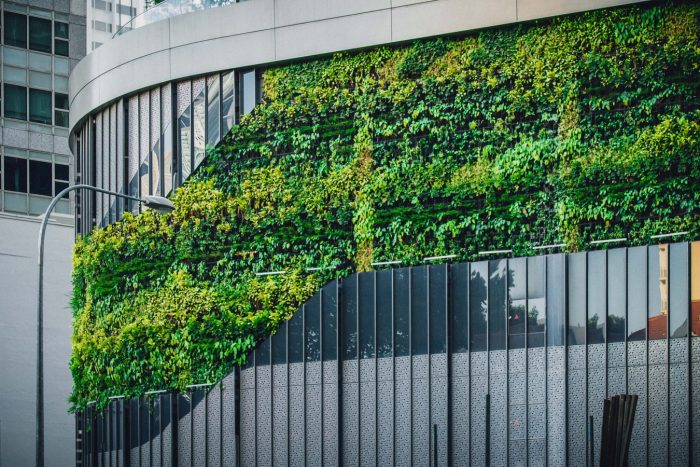
Ok, to be fair, this one is not so popular in the States (yet), but it’s just awesome. Also a pretty simple concept, though this one needs some serious planning in execution. Basically, it’s a building covered with trees, flowers, ferns and whatever else you can fit on it.

The architect used more than 20,000 trees and plants to adorn the high-rise buildings from top to bottom (Credit: AFP)

In addition to cleaning the air, vertical forests replace some of the animal habitat that has been displaced by the tremendous growth of cities in the last century. Not to mention how simply breathtaking they are. If you like a challenge, this is a great one. Plumbing, electrical, structural, landscaping, engineering. All of them have to be perfect for the forest to survive and the building to stand solid.

Bosco Verticale Schematic by Stefano Boeri Architects

Such forests have already been constructed in Singapore, China, Australia and a few locations in Europe. Holland is building a low-income housing vertical forest. Even Iran’s going to have one soon!

Credit: Carlo Alberto Mari

Sustainable building is a great opportunity for contractors to be a part of something that helps the planet and their bottom line. These are just a few examples of ways to expand your business with eco-friendly building materials and practices. Look into it and don’t let your competitors get ahead of you on this!