We Tested the 3 Best Subcontractor Compliance Management Software Tools — Find Out Which Came Out on Top

subcontractor compliance management tool thumbnail

Here’s the criteria we evaluated each subcontractor compliance management tool on:

—Product Features
—Industry Specializations
—Customer Support
—Integrations
—Quality of Insurance Review

The Final Verdict

—Jones is the top overall subcontractor compliance management tool, with the highest standards of document review, frictionless no-login document uploads, and the only embedded Procore integration (read more about embedded integrations here). However, Jones only serves GC and CRE, so companies from other industries need to look elsewhere.

myCOI brings years of experience to the table, but reportedly has struggled to review documents in a timely manner over the last 9 months to a year. It does serve more industries than its competitors, so anyone looking to manage insurance for trucking, waste management, commercial marijuana sales, or aviation may want to choose this option.

Trustlayer has good customer support and manages the collection and review of insurance documents end to end, but minimal reporting options and confusion over requirements make acting on compliance issues difficult.

In this guide

—Features to Look for in a Subcontractor Compliance Tool
—Comparing Three Top Subcontractor Compliance Management Software Tools
—Crowning the Best Subcontractor Compliance Management Tool

Note: interested in exploring how Jones can help you automate your subcontractor compliance management end-to-end and de-risk all your projects? Talk to our team of experts today!

Let’s Chat!

Features to Look for in a Subcontractor Compliance Management Tool

Not all subcontractor compliance solutions created equal. Ask about these 5 key criteria when you’re choosing the right subcontractor compliance management tool for your GC.

Fast COI and Endorsement Review Times

Slow insurance document review that prevents subcontractors from quickly getting to work spurs many GCs to begin searching for a subcontractor compliance tool. Ask the subcontractor compliance tool vendor what their average turnaround time is for a COI and endorsement review. If their average review time is over 24 business hours, look elsewhere.

TL;DR: If a subcontractor compliance tool can’t commit to sub-24 hours document review times you should look elsewhere. 

Ease of Use for Subcontractors

If your subcontractor compliance management tool makes it difficult for subcontractors to upload their documents by asking them to create an account and password, they’re going to be less likely to submit their documents and less likely to want to work with you in the future. No-login flows are the lowest friction option.

TL;DR: Look for a solution that has an easy document upload flow and requires minimum input from your subs.

Built for the Needs of the Construction Industry

Most of the COI trackers available today are industry agnostic and capable of serving a wide variety of different companies. As a GC, that should be a red flag. Construction takes risk exponentially more seriously than most other industries, and there are many industry-specific concepts, coverages, forms, and certificates that your software should be familiar with. Make sure the tool you choose supports GC specific workflows and is capable of sorting subcontractors on both a global and project level.

TL;DR: If a subcontractor compliance tool boasts about serving over 20 industries, you can be almost certain that it’s not a specific enough platform for the high risk world of construction.

Bonus: Embedded Integration with Procore

subcontractor compliance management tool procore integration comparison

If your organization uses Procore, ensuring the subcontractor compliance tool you choose has an embedded integration with Procore should be nonnegotiable. With an embedded integration, users don’t need to constantly switch between Procore and an App in order to perform core tasks. An embedded Procore integration is capable of both pushing information to and from another system, so your subcontractor compliance tool should both be able to push and receive data to and from Procore. Otherwise you’ll be stuck having to manually update Procore every time you collect a new set of subcontractor insurance documents, and manually update your compliance software every time you create a new project. 

TL;DR: If the subcontractor compliance tool you choose doesn’t integrate with Procore and the other software in your stack, you’re going to be stuck with a lot of additional manual data entry.

Comparing Three Top Subcontractor Compliance Management Tools

Now that we’ve discussed the must-have features of any subcontractor compliance tool, let’s go over three of the leading players in the space: Jones, myCOI, and Trustlayer. Each solution has pros and cons that make them right for the needs of different organizations.

Jones: The Top Overall Subcontractor Compliance Management Tool

Jones is the top subcontractor compliance management solution on the market, bringing GC specific workflows and high quality of document reviews to the table as well as an embedded integration with Procore. However, it’s only an option for brands in the GC and CRE spaces.

Advantages of Jones as a Subcontractor Compliance Management Tool

Commitment Triggered COI Requests and Global Insurance Requirements via Procore Integration

commitment triggered COI request in Jones subcontractor compliance management tool

Jones is the only subcontractor compliance management tool with an embedded Procore integration. Jones eliminates all confusion over COI collection by sending automatic notifications whenever new commitments are created in Procore, making it nearly impossible to miss requesting COIs. Jones also makes managing Global Insurance Requirements directly in Procore simple, with categorization capabilities to differentiate global-level subs from project specific subs.

Fast and Accurate Document Review
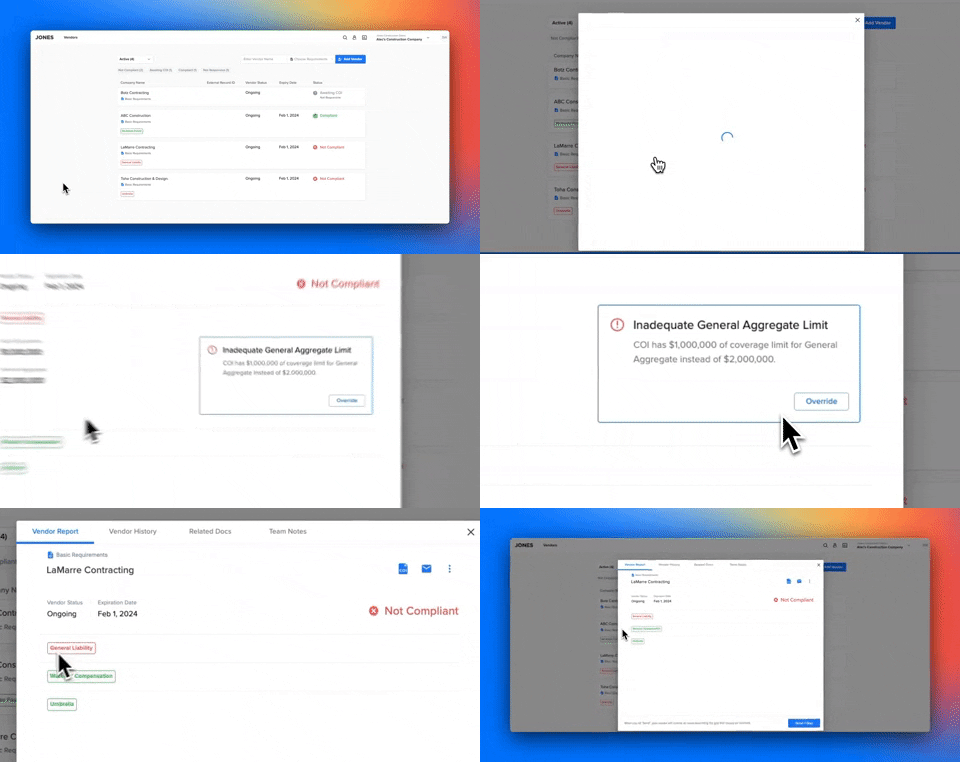
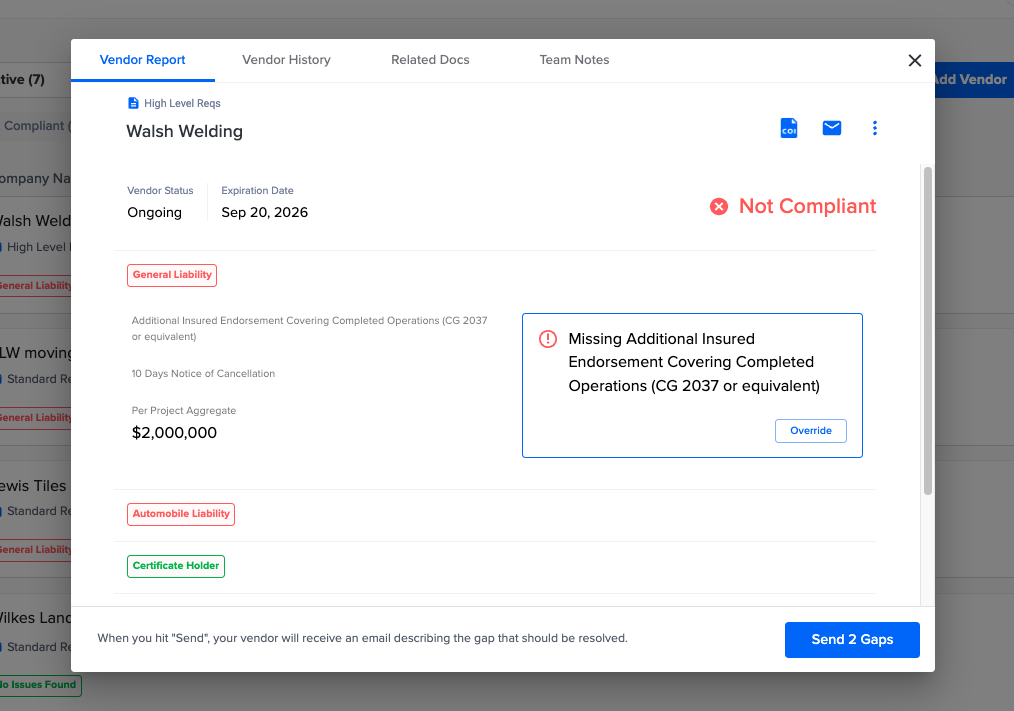
gap report in jones subcontractor compliance management tool

Jones maintains a sub-24 hour standard document review time, with 99.6% accuracy over the course of 1.5 million COI and endorsement reviews. The combination of review accuracy and speed is one of the primary selling points of the Jones platform. Customers have reported a significant increase in document review quality and efficiency when switching to Jones from myCOI and Trustlayer.

Login-Free Document Uploads
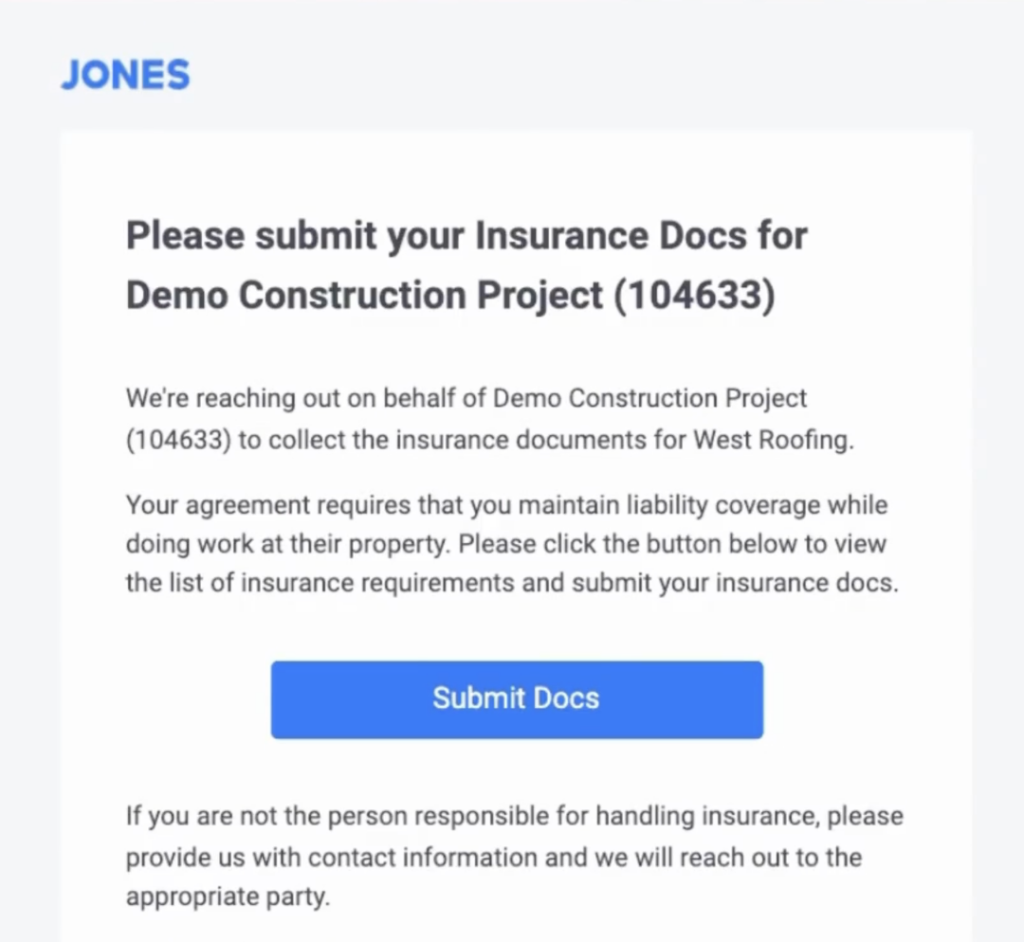
subcontractor compliance management tool document upload flow

Jones allows subcontractors to upload insurance documents without creating an account. This increases collection rates by 2x and was a deciding factor for several clients who switched off myCOI early to migrate to the Jones platform who reported their subs “hated having to register to submit documents.” 

Disadvantages of Jones as a Subcontractor Compliance Management Tool

Only Serves Two Industries

Unfortunately for non-GC and CRE companies looking for a subcontractor compliance tool, Jones isn’t best suited for them. As an industry-specific solution, Jones workflows are designed to fit the unique needs of the construction and CRE spaces.

Rigorous Auditing Standards Can Cause Initial Low Compliance

Jones customers are occasionally surprised at their initial low compliance numbers when onboarding onto the Jones platform. However, this is largely as a result of the fact that the company is only beginning to see the state of how their compliance really has been handled in the past. With some quick adjustments and revision of problematic requirements, customers are quickly able to boost their numbers on Jones.

myCOI: The Subcontractor Compliance Management Tool Serving the Widest Variety of Industries

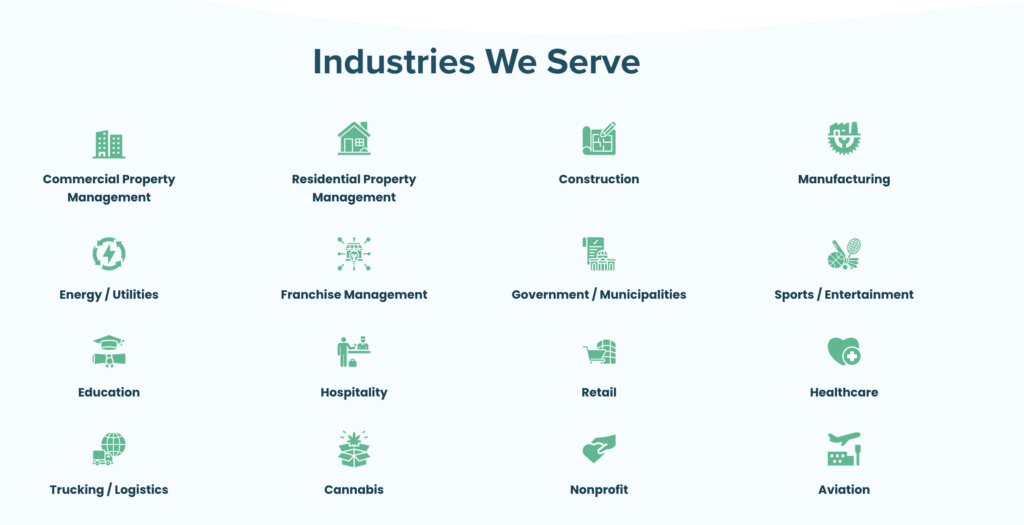
myCOI is a legacy COI tracking tool that serves multiple industries including education, real estate, manufacturing, hospitality, cannabis sales, and more. They’re one of the original brands in the subcontractor compliance space. Let’s break down some of the pros and cons of the myCOI platform.

Advantages of myCOI as a Subcontractor Compliance Management Tool

Lots of Industries Served
mycoi subcontractor compliance management tool industries served

As briefly mentioned before, myCOI can help organizations in a variety of industries with the management of their subcontractor and vendor COIs and endorsements. The industries myCOI offers their services to include those mentioned above, as well as government, waste management, and transportation. For companies in these spaces looking to manage their subcontractor compliance, myCOI is a good choice.

Over 15 Years in Business

As a legacy brand, myCOI has a long track record of delivering value to its customers. With fifteen years of experience in the subcontractor compliance industry, myCOI has proven that longevity isn’t a concern. If you opt to have myCOI manage your subcontractor compliance, you can rest assured that they’ll be around in the years to come. Considering claims can surface years after projects are completed, that’s key.

Disadvantages of myCOI as a Subcontractor Compliance Management Tool

Slow Document Review

Customers have reported myCOI’s average document review time to range anywhere from several days to several weeks. We have heard from multiple former customers that myCOI has cited a “period of unprecedented growth” as the cause for delays in subcontractor COI and endorsement reviews. If they’re struggling to keep up with an influx of submissions, adding additional customers can only be expected to continue to increase the average time for myCOI’s document checks.

Limited Procore Integration Capabilities
mycoi forum quote

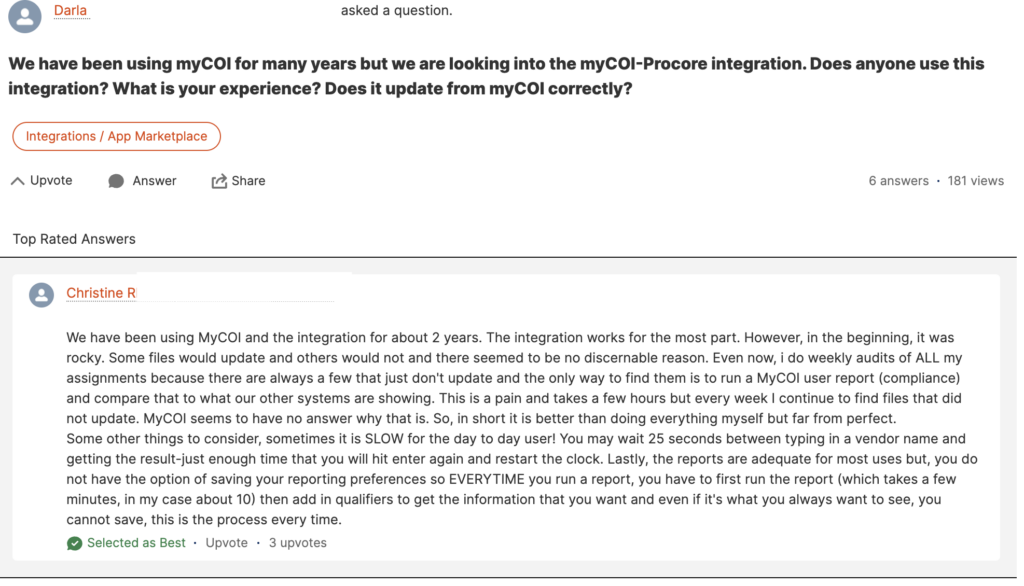
myCOI does offer an integration with Procore. However, customer reports on the Procore forums indicate that the capabilities of the integration fall short of expectations. One customer reported that their Procore integration with myCOI failed to properly sync, with no explanation from myCOI. While still better than having to manually upload data, the fact their Procore integration is only a one way data connection greatly limits its capabilities compared to the embedded Jones Procore integration.

Upsells Insurance Products to “Noncompliant” Vendors
mycoi broker complaint

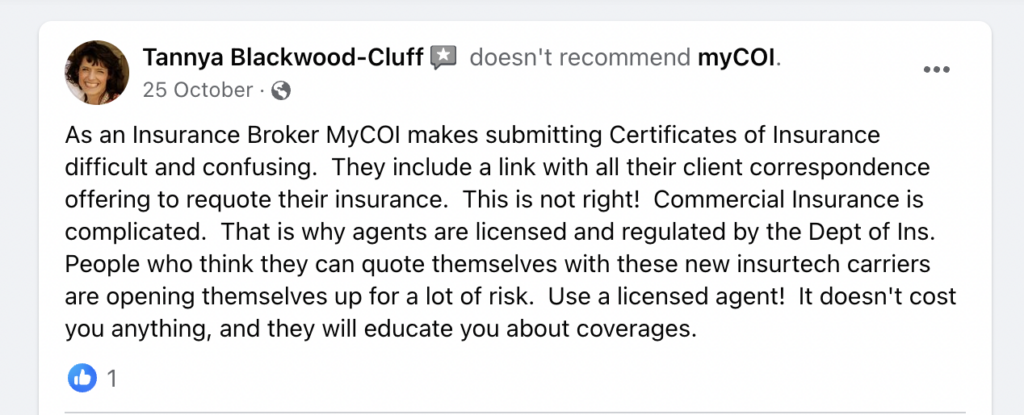
Recent online reviews of myCOI from licensed insurance brokers indicate that myCOI attempts to use noncompliant subcontractor records as an opportunity to upsell their own insurance products. Considering they are the arbiter of subcontractor compliance, trying to sell insurance based on judgements they issue is a precarious proposition. COI stands for “Certificate of Insurance”, but in the case of using compliance status to sell insurance products COI might as well stand for conflict of interest.

Trustlayer: Good Customer Support with Reporting and GC-Specific Shortcomings

Trustlayer is a newer company than myCOI, and brings high level customer support and an end-to-end process to the table. However, shortcomings in their document review capabilities and lack of reporting capabilities make taking action difficult.

Advantages of Trustlayer as a Subcontractor Compliance Management Tool

Good Customer Support

Reviews online highlight the high quality of Trustlayers’ customer service. One review indicated their customer support was the best part of the value proposition, while noting that their AI occasionally struggles to ready insurance documents. However, she mentioned that the CS team at Trustlayer helped overcome any product issues she had.

Handling Communication of Gaps to Subcontractors

By taking the communication of gaps off the GC’s plate, Trustlayer minimizes the need for back and forth conversations with subcontractors about insurance. This gives GC accounting and risk teams time back to handle other tasks.

Disadvantages of Trustlayer as a Subcontractor Compliance Management Tool

Procore Integration Can Only Track Subs on a Global Level

Conversations with former Trustlayer customers have indicated that Trustlayer is not able to store global-level subcontractors and project specific subcontractors separately with their Procore integration. As our guide to Global-Level Insurance Requirements showed, being able to distinguish these two groups is key. Unfortunately, it’s not an option in the Trustlayer platform. 

Minimal Reporting Capabilities
trustlayer g2 review

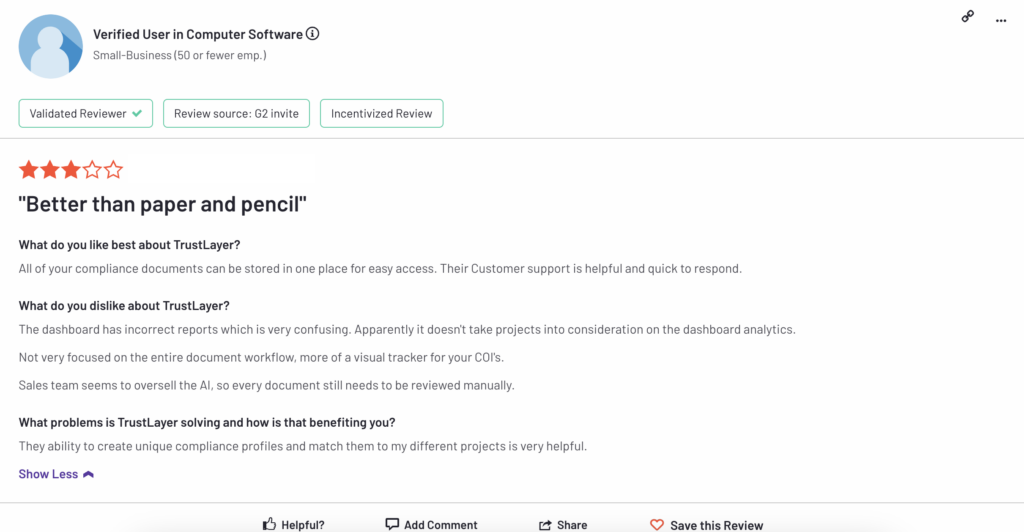
A former Trustlayer customer reported in a call with us that “there are no reporting capabilities to help [them] figure out why vendors aren’t compliant without drilling down into every interaction they had with Trustlayer.” Another certified G2 review echoed these complaints, indicating that Trustlayer’s dashboards tools were a significant shortcoming of the platform. A lack of reporting options make visualizing compliance difficult, which is a concern for Trustlayer customers.

Confusion Over Requirements

If a subcontractor compliance management tool can’t get your requirements right it’s a massive issue, as you may not have the coverages required to protect your organization from risk. Former Trustlayer customers have reported that “oftentimes Trustlayer asks for requirements that [they] don’t mandate” and that subsequently it takes their team “far more effort than necessary to get vendors compliant.” Not being able to follow requirements is a major red flag for Trustlayer.

Crowning the Best Subcontractor Compliance Management Tool

All three of the tools listed have strengths and weaknesses, but it’s Jones that comes out on top after a head-to-head comparison. Whether it’s the Jones embedded Procore integration, the speed and accuracy of insurance document review, or the login-free document upload flow, Jones should be the subcontractor compliance management tool of choice for GCs. Get in touch with the Jones team via the form below to learn more.

5 Insurance Compliance Strategies to Improve Construction Accounts Payable

At Jones, we collect and review COIs and endorsements for ENR 400 GCs. We asked accountants at customer GCs including Manhattan Construction, Harvey-Cleary, and Bogard Construction for strategies to reduce manual effort and expedite their insurance compliance process to improve AP. Here’s the quick rundown of what they shared with us:

Key Takeaways:

  1. Use Global Insurance Requirements to issue multiple subcontractor payments with only one set of compliant subcontractor documents.
  2. Centralize your insurance communications in one place to reduce the risk of communication breakdowns that can cause payment delays.
  3. Improve your team’s insurance document review skills to minimize the risk of payments going out to a noncompliant sub.
  4. Simplify the way you communicate gaps to subs to increase your COI collection rate by 2x.
  5. Implement a dedicated insurance compliance solution to increase compliance rates by 70% and reduce COI review times by over 3x.

Read on for a deeper dive.

In this post:

Note: interested in exploring how Jones can help you automate your compliance management end-to-end and de-risk your projects? Talk to our team of experts today!

Let’s Chat!

Diagnosing Insurance Obstacles to Improving Construction Accounts Payable

The accounting teams we spoke to cited four primary insurance compliance obstacles that they experienced before bringing Jones on as a subcontractor compliance management tool

  1. Unnecessary Volume of Documentation
  2. Insurance Review Is Complicated and Unintuitive 
  3. Repeated Manual Data Input Required
  4. Communication Breakdowns During Document Review

Any of these sound familiar? Don’t let them get in the way of improving your construction accounts payable. We have some strategies that can help.

Strategies for Improving Construction Accounts Payable

Making a few small improvements to your subcontractor insurance compliance process can both reduce your average DPO and minimize the risk of payment going out to a noncompliant subcontractor. The accountants we spoke to shared these five best practice ideas:

Adopt Global-Level Insurance Requirements for Trusted Subcontractors to Improve Construction Accounts Payable

When it comes to issuing payments, using project-level requirements means your accountants have to check project by project compliance status when sending out checks. Solution? Global-level insurance requirements for trusted subcontractors. Global subs only need one compliant set of insurance documents to work on any project, using the right blanket Additional Insured endorsements to protect both your GC and various project owners. You also only have to collect subcontractor insurance documents once a year.

By implementing global-level insurance requirements for certain trusted subs, you allow your accounting team to send multiple payments at once. Plus, less identical copies of insurance documents reduces unnecessary documentation in your systems.

improve construction accounts payable with global requirements in Jones

With Jones, collecting and managing global-level certificates is a breeze. The Global Insurance Requirements feature of the Jones Procore integration makes it simple to store global-level insurance documentation and add global subs to projects. Read more on the Global Insurance Requirements in the Jones Procore integration here.

Centralize Insurance Communications to Improve Construction Accounts Payable

Jones data shows communication breakdowns are one of the primary reasons for subcontractor payment delays. Whether it’s spam filters catching emails from different domains, difficulty looping in a broker, or just a case of overloaded inboxes, struggling to stay on the same page during the insurance component of the AP process can negatively impact relationships with subs. Strategies for centralizing communications include:

  • Centralize your insurance communications in a communal inbox, insurance@*your GC’s domain*
  • Have your IT department whitelist subcontractor email domains
  • Ask if your broker could set up a dedicated inbox for your GC

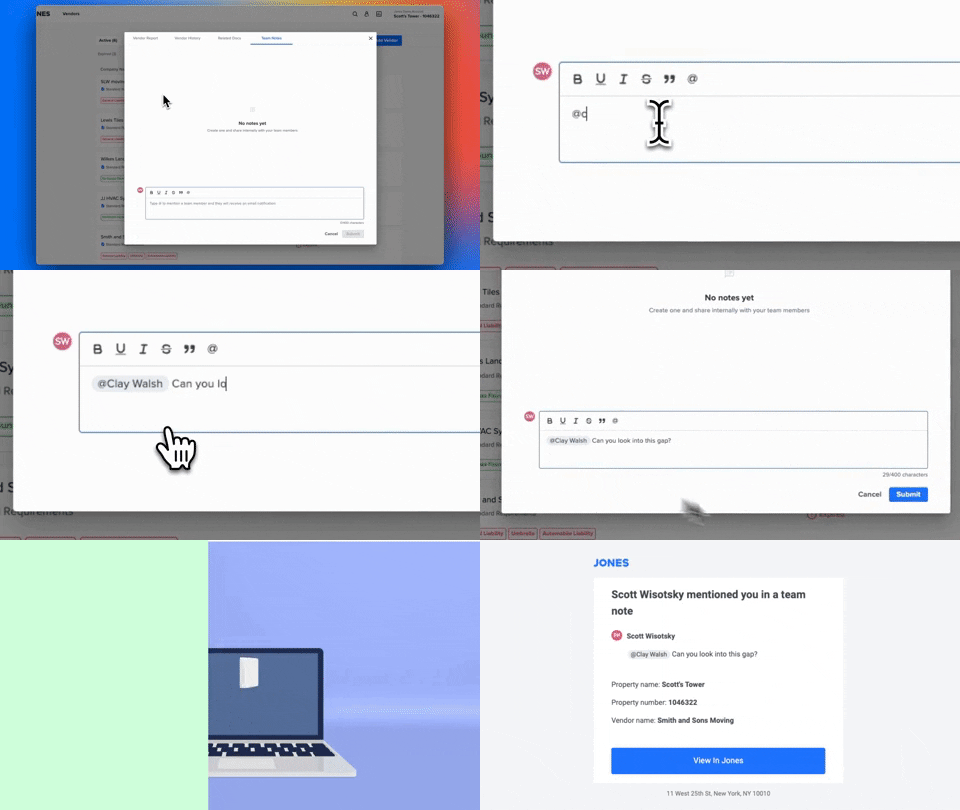
improve construction accounts payable by tagging team members

Jones makes collaborating on insurance document review simple. All you have to do is leave notes and tag team members on subcontractor insurance records. That means looping in a broker or risk management professional for their inputs is easier than ever. With Jones, you can eliminate fumbled document handoffs and payment delays as a result of communication breakdowns.

Upskill Your Team on Insurance Document Review to Improve Construction Accounts Payable

Ensuring your accounting team is well trained to review COIs and endorsements is a crucial part of protecting your GC from insurance risk. By upskilling your accounting team with insurance courses you minimize the risk of an error in document review causing payment to go out to a noncompliant subcontractor. Looking for helpful insurance resources for your team? Get a copy of our easy-to-use COI review blueprint, or browse our comprehensive insurance guide.

improve construction accounts payable with better COI reviews

Rather have the collection and review of COIs off your plate entirely? Have Jones handle it. Our team maintains a 99.6% accuracy rate in COI and endorsement review. The team is familiar with all manner of common and uncommon insurance endorsements, and is able to customize the way we review to fit the unique risk tolerance of every GC. As Sarah Michels, Office and Contract Manager at Bogard Construction told us, she’s “very confident when [she] looks and Jones says compliant, that it’s compliant with what [Bogard] needs.”

Simplified Communication of Gaps to Subcontractors

When subs are confused by gaps they’re much less likely to resubmit their insurance documents than when they’re explained clearly. Try simplifying the way you communicate gaps using bullet points and clearly writing out your required limits. You can go above and beyond with this too–Sarah from Bogard developed a guide that listed all the endorsements and equivalents Bogard accepts to be distributed to their subs, boosting their collection and compliance rates.

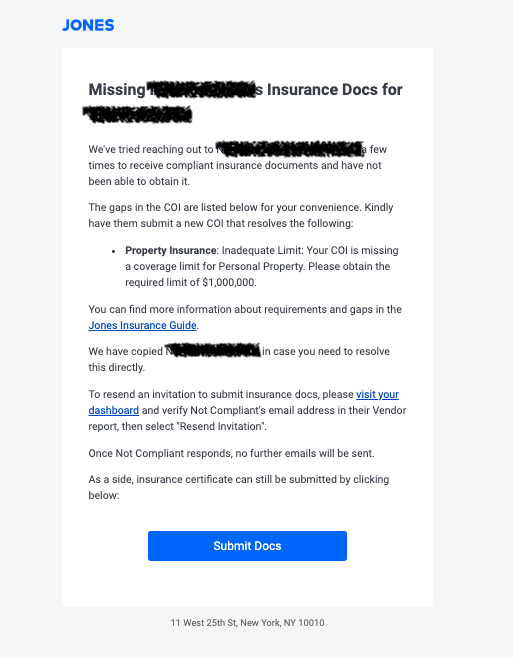
jones gap email

Jones takes the communication of gaps off the plate of accounting teams, handling all insurance related conversations with subcontractors. Our clear, easy to understand gap emails explain what insurance coverage gaps exist and how to rectify them. In addition, our detailed insurance guide is a helpful resource for subcontractors who are less familiar with the complicated world of insurance.

Implement a Dedicated Insurance Compliance Solution to Improve Construction Accounts Payable

Consider implementing an insurance compliance solution that consolidates everything to do with COIs and endorsements in one place. This can help your team issue payments faster and makes looping in risk managers or your broker far simpler than in long email threads. The solution should be capable of seamlessly syncing data between your ERP, accounting software, and construction management platform, which eliminates the need for duplicate data entry. Storing all your COIs and endorsements in a dedicated system can significantly help in case of a claim down the road.

Looking for a dedicated insurance compliance solution to help improve your construction accounts payable? Look no further than Jones.

How Accounting Teams Improve Construction Accounts Payable with Jones

With Jones, accounting teams at GCs have the tool they need to expedite and simplify the insurance component of the accounts payable process. By eliminating the need to collect and review COIs, accountants have more time to manage lien waivers, change orders, certified payroll, and more. The Jones integration seamlessly pushes data to Procore and Sage, eliminating the need for hours of manual data entry. And with Jones, getting input from risk managers and insurance brokers is faster than ever before. What does all that mean? Faster payments, minimized risk of noncompliance, and more time back to manage every other part of the AP process. Get in touch with us via the form below to learn more about how Jones can help your accounting team improve their construction accounts payable process today. 

Blanket Insurance Requirements: How You Can Minimize Subcontractor Friction and Reduce Admin Work

A Deep Dive into Blanket Insurance Requirements

Table of Contents


Blanket insurance requirements have limits and endorsements that make them applicable to ALL your projects rather than specific to one project, meaning a subcontractor only needs one set of compliant insurance documents to work on any project in your portfolio. Let’s dive deeper into what blanket insurance requirements are, how you can implement them at your GC, and how the Jones Procore integration makes managing global subcontractors simple.

Note: interested in exploring how Jones can help you automate your compliance management end-to-end and de-risk your projects? Talk to our team of experts today!

Let’s Chat!

What Are Blanket Insurance Requirements (AKA Annual Insurance Requirements?)

Blanket insurance requirements have limits, endorsements, and coverages that can be applied to all projects in a company’s portfolio, and use broader Additional Insured language that extends Additional Insured coverage to “all parties as required per written contract.” Rather than using project-level requirements that only allow a subcontractor to be made compliant for a single project, blanket requirements allow one COI to be marked as compliant across all a company’s projects.  This means a subcontractor only has to submit one set of COIs and endorsements to work on any project in a company’s portfolio. Not only does this simplify compliance for GC risk teams, but also means subcontractors and their insurance brokers don’t have to waste time submitting the same documents over and over for each project. 

Blanket insurance requirements can also go by different names. We frequently hear our customers refer to them as annual insurance requirements, because subcontractor documents only need to be collected once per year. No matter what you choose to call them, here’s the benefits of selectively deploying them at your company.

Why Use Blanket Insurance Requirements?

Implementing them can have a positive impact on multiple aspects of the insurance compliance process. Here’s a quick breakdown of how using them could help improve different processes at your organization.

Reduce Admin Time Spent Collecting and Reviewing COIs

Contract managers and office staff reduce administrative overhead by limiting the amount of time spent communicating insurance gaps to subs. Plus, they no longer have to spend time reviewing and organizing the same COIs. Using blanket insurance requirements also greatly reduces the amount of duplicate records a GC has to keep on file. One of our customers told us that before implementing blanket insurance requirements their internal systems were stuffed with an “overwhelming number of duplicate records.” Having dozens of copies of the same documents floating around their databases made reporting on and monitoring subcontractor compliance a huge headache.

Simplify Subcontractor Prequalification

Subcontractor prequalification can also be expedited by using blanket insurance requirements. If your subcontractor has up-to-date, compliant insurance documentation because they’re already a global subcontractor, the insurance component of the prequalification process becomes almost an afterthought. For one GC risk team, reducing the administrative overhead of prequalification means they can use subcontractors “again and again, and can get started faster” on new jobs.

Expedite the Accounts Payable Process

When issuing payments to subcontractors without blanket insurance requirements, accounting teams check compliance on project by project basis to disburse funds. This makes it significantly harder to ensure all payments go out on time and increases the likelihood of a subcontractor filing a lien. With blanket insurance requirements, accounting teams can issue multiple payments at once for all the projects a subcontractor is working on if they’re compliant with the one compliant global COI. 

Eliminate Compliance Related Friction for Subcontractors

Another big advantage is the reduction of compliance tasks for subcontractors. Subcontractors: 

  • Only have to submit insurance documentation once a year
  • Need to loop in their insurance brokers less frequently
  • Can get started on new projects quicker

With blanket insurance requirements subs can get approved faster, get to work faster, and get paid faster. Risk managers we’ve spoken to mentioned that their subs are “eager to get set up as global subcontractors” once they’re told about the benefits of the arrangement.   

However, there are certain cases in which implementing project specific requirements is still the right approach to mitigating insurance risk. Let’s dive into how we’ve seen GCs decide when to use and when not to use blanket insurance requirements.

Choosing When to Use Blanket Insurance Requirements

There are several insurance considerations to take into account when choosing which subcontractors to use blanket insurance requirements for. Here’s some indicators that blanket insurance requirements might be a fit:

  • Relatively standard project to project requirements that don’t include high-risk exceptions or exclusions
  • Company uses blanket Additional Insured endorsements with “as per written contract” verbiage to confer coverage to GC/ownership
  • The subs in question are either low risk trades, or have long standing relationships with the GC

While there are no hard and fast rules for when to use blanket insurance requirements, these three criteria are a good place to start when choosing which subcontractors to make global. Here’s how one of our GC customers decides which subcontractors should be put on blanket insurance requirements.

One GC Shares Their Process for Selecting Subcontractors for Blanket Insurance Requirements

We spoke to a risk management specialist at an ENR 400 GC about how her team chooses which subcontractors to roll out blanket insurance requirements to. Here’s how her decision making process goes:

  1. Identify subcontractors who are already working on multiple projects
  2. Ensure the subcontractor has always been responsive
  3. Check if the subcontractor has a track record of being proactive and engaged on compliance
  4. Ensure the subcontractor can provide a blanket Additional Insured endorsement
  5. Ensure the subcontractor has an interest in working with them again

After ensuring that a subcontractor meets these criteria, the risk management specialist will reach out to them about setting up blanket insurance requirements. In general, their subcontractors have been very receptive to being made globally compliant once they’re made aware of how much administrative work they’ll be cutting out.

Choosing When to Use Project-Specific Requirements

There are, however, cases in which project-specific requirements are the correct option due to the increased risk profile of the project. These are some cases in which we’ve seen GCs opt for project specific requirements:

  • Specialty coverages (like pollution) are required 
  • The unique risk tolerance of a project owner means they won’t accept blanket Additional Insured endorsements
  • Special exclusions (like height or scaffolding exclusions in dense urban centers like New York or Chicago) exist
  • When working with small subcontractors who may have difficulty securing blanket Additional Insured endorsements for cost reasons
  • When working with one-off subcontractors

Using the right mix of blanket requirements and project-specific requirements helps effectively insulate your GC from risk while simultaneously removing administrative barriers that prevent subcontractors from getting to work. How can you go about implementing blanket insurance requirements at your organization?

Getting Started with Blanket Insurance Requirements

When choosing to implement blanket insurance requirements, it’s crucial to do so strategically. Trying to suddenly elevate all of your subcontractors to global subcontractor status without considering the risk implications could result in gaps that leave your company exposed to insurance risk. We asked several GC risk teams how they went about implementing blanket insurance requirements – here’s what they shared with us. 

Shortlist Qualified Subcontractors

The risk teams we spoke to stressed that you should only roll blanket insurance requirements out to reliable and responsible subcontractors. What kind of factors should you take into consideration when choosing which subcontractors should be global?

  • Subcontractor claims history
  • Subcontractor insurance coverage 
  • Existing relationship with subcontractor
  • Inherent risk of the specific trade
  • Types of projects the subcontractor typically works on (single-family homes vs. skyscrapers, etc.)

Once you’ve shortlisted your reliable, low-risk subcontractors it’s time to move on to designing a blanket insurance requirement set that is simultaneously widely applicable across your projects and specific enough to ensure you’re adequately covered in the event of a claim.

Design a Blanket Insurance Requirement Set

A well designed blanket insurance requirements set protects GCs from risk by being broad enough to apply to a variety of projects but stringent enough to provide adequate coverage in the event of a claim. Here are some trends we’ve identified from our GC customers’ blanket insurance requirement sets compared to their project-specific requirements:

  • Higher average Workers’ Compensation and umbrella liability limits
    • On average, WC limits are 200 percent higher for global-level
    • On average, umbrella limits are 500 percent higher for global-level 
  • Increased amount of additional GL coverages required, including damage to rented premises and medical expenses
  • 100% inclusion of blanket Additional Insured requirements with “as required by written contract” verbiage in order to confer coverage to the GC, project owner, and all other required parties
  • Similar or identical endorsements (Primary & Noncontributory, Waiver of Subrogation, 30 Days Notice of Cancellation, CG 2010/2037s, etc.) for GL and auto liability

As each GCs insurance needs and risk tolerance levels are different these trends may not necessarily be a fit for every company, but they provide some context as to how other GCs design their requirement sets. However, one non-negotiable component of blanket insurance requirements is the blanket Additional Insured verbiage that confers AI status to everyone who needs it.

Collect and Review Subcontractor COIs and Endorsements

Now that you’ve done all the prep work for blanket insurance requirements it’s time to get into the nitty gritty–collecting and reviewing COIs and endorsements (Struggling to review COIs for compliance? Download our COI review blueprint.) This process is one you’re probably already familiar with, and doesn’t look any different for blanket insurance requirements than it does for project-specific requirements. However, rather than being forced to address gaps on multiple COIs for one subcontractor, you only have to resolve the issues one time to get a subcontractor compliant across your projects. Once you’ve sorted out the gaps, your global subcontractor can immediately get to work on any project. During the review of endorsements ensure your subcontractor has provided a blanket Additional Insured endorsement that extends coverage not only to your GC but the project owner too.

Potential Roadblocks to Implementing Blanket Requirements

One of our GC customers shared one large pitfall with us that prevented them from fully taking advantage of blanket insurance requirements: a lack of organizational capabilities in their existing system. The COI management software they were using had no specific way to designate a global subcontractor from a project subcontractor, leaving global subcontractors “mixed in alphabetically with [their] project subcontractors.” This defeated the purpose of segmenting their subcontractors to begin with. Without the correct system or software in place, segmenting project-specific versus global subcontractors became an additional administrative nightmare. Fortunately, they found a better way to handle their blanket insurance requirements in Procore–with the Jones Procore integration.

Introducing Global Insurance Requirements via the Jones Procore Integration

When you do want to extend broad coverage to a subcontractor across your portfolio it’s easier with the Global Insurance Requirements feature from Jones. It allows Procore users to use one compliant subcontractor COI for multiple projects across their account. With this feature it’s faster than ever to get subcontractors on site, eliminating the need to collect and check the same insurance documents for different projects within one portfolio. We’ve seen that Jones customers who use Global Insurance Requirements see an average of 18% higher compliance for their trusted subcontractors as opposed to using project specific requirements.

What Using Global Insurance Requirements in Jones Looks Like

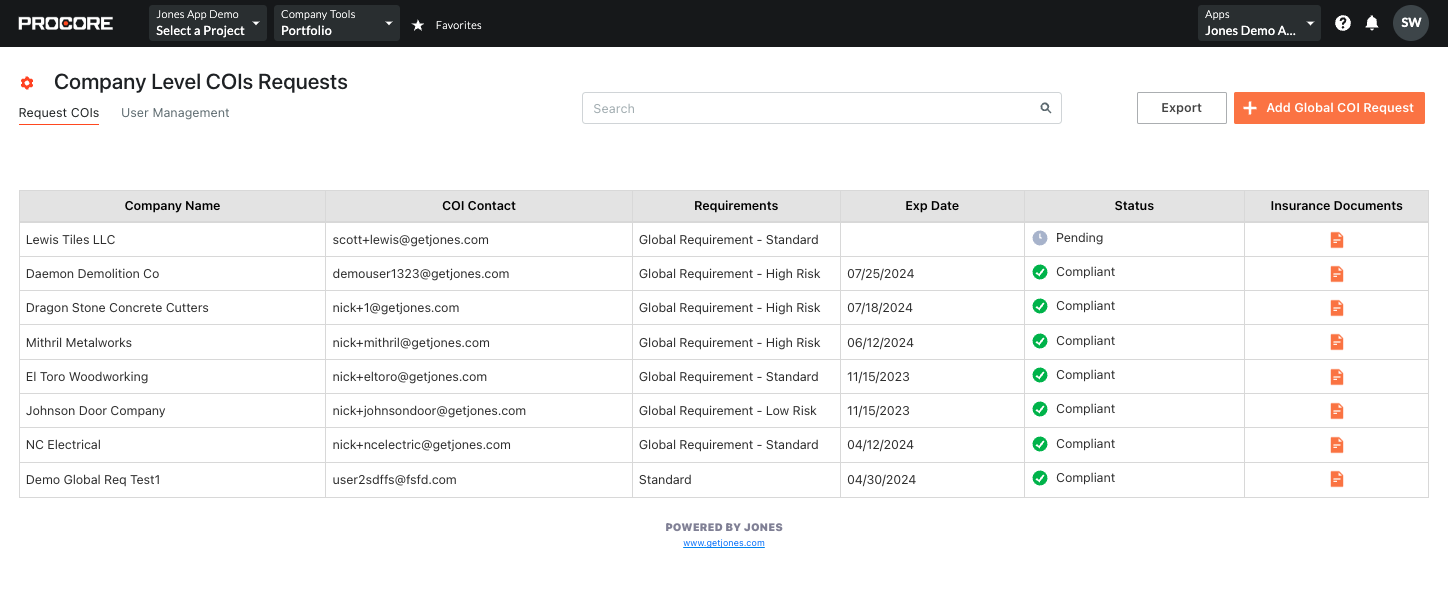
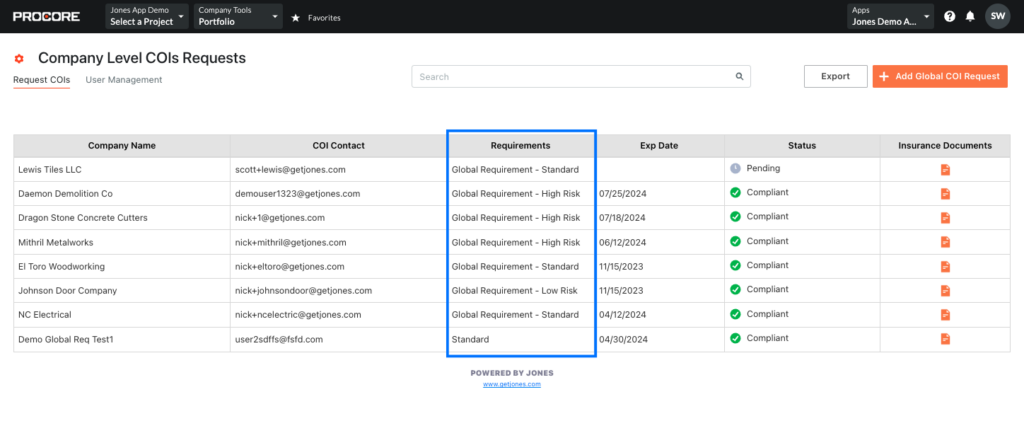
When you open the Jones Procore app, you’ll see a list of all the companies with global-level requirements. You can initiate a global-level COI Request from the Procore home screen. 

blanket insurance requirements in Jones/Procore

Adding a new subcontractor with Global Insurance Requirements is simple.

  • Click the “Add Global COI Request” button on the upper right-hand corner. 
  • From there, requesting a COI with Global-level insurance requirements is simple. You’ll just need to choose the subcontractor and select or create the set of global insurance requirements.
  • Once you’ve requested a COI from a subcontractor with global-level insurance requirements, they will be visible at the bottom of all projects across your account.

It’s important to note that you can only send global-level COI requests to companies listed in your Procore company directory. It’s also important to note that all vendors with global-level insurance requirements are created as new records in a separate project within Jones.

Getting Started with Blanket Insurance Requirements

Does granting global compliance status to a subcontractor come with its own set of risk considerations? Absolutely. But in a relationship-driven industry like construction, any additional friction in the subcontractor insurance compliance process could have an impact on a GC’s bottom line. There are too many other pieces of the risk management puzzle to manage for COIs to come between a GC and a subcontractor they want to work with again and again. That’s where global-level insurance requirements come in to help reduce the amount of insurance documentation your subcontractors have to submit and your risk team has to review. And if you’re thinking about implementing global-level insurance requirements, it’s crucial to have a subcontractor compliance management tool  in place to help organize your insurance documents on a global vs. project level. That’s where we come in– get in touch with us via the form below to learn more about how Jones helps implement blanket insurance requirements with Global Insurance Requirements in Procore.