Why is a COI in Construction Critical for Compliance?

Why is a COI in Construction Critical for Compliance?

What Is a COI in Construction?

A certificate of insurance is a summary document issued by an insurance broker that shows proof of insurance coverage. In construction, it’s typically required from subcontractors, vendors, and any third parties working on a job site.

It includes:

  • The name of the insured (your subcontractor or vendor)
  • Types of coverage (e.g., General Liability, Workers’ Comp, Auto)
  • Policy numbers and insurance carriers
  • Effective and expiration dates
  • Coverage limits

But here’s what it doesn’t do: guarantee compliance.

The COI is only a summary. It doesn’t prove that the required endorsements are in place. It doesn’t confirm that the owner or GC has been added as an Additional Insured (unless that status is backed by a formal policy endorsement, such as a blanket Additional Insured endorsement). It doesn’t show exclusions that might gut coverage. And yet, it’s the most relied upon document in insurance compliance workflows.

This reliance on an incomplete document is one of the biggest pitfalls in construction compliance. Without supporting endorsements or policy details, teams are making approval decisions based on surface-level data – a risky move when millions of dollars are on the line.

Jones helps solve this by complementing COI management with full policy verification (e.g. flagging exclusions like Height or EIFS), reviewing endorsements, checking AM Best Ratings to ensure carrier solvency, and incorporating Indemnification Agreement workflows to strengthen risk transfer.

In an example below, a COI appears as fully compliant with a company’s insurance requirements. However, upon checking the full policy, it’s clear that the subcontractor’s General Liability policy contains Residential exclusion.

ACME Construction’s insurance: only COI is checked for compliance
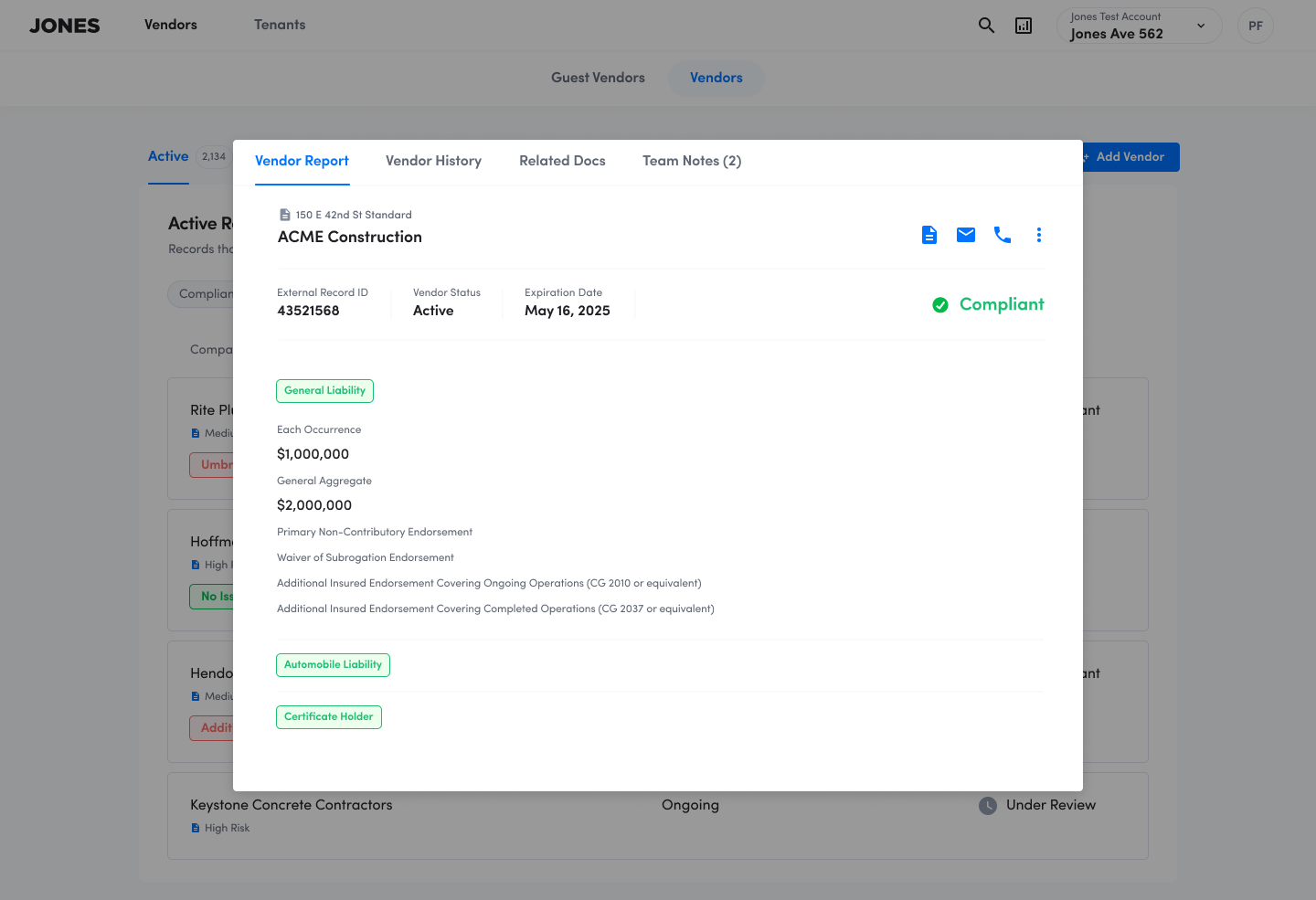
Why is a COI in Construction Critical for Compliance: compliant COI

ACME Construction’s insurance: full CGL policy is checked for compliance
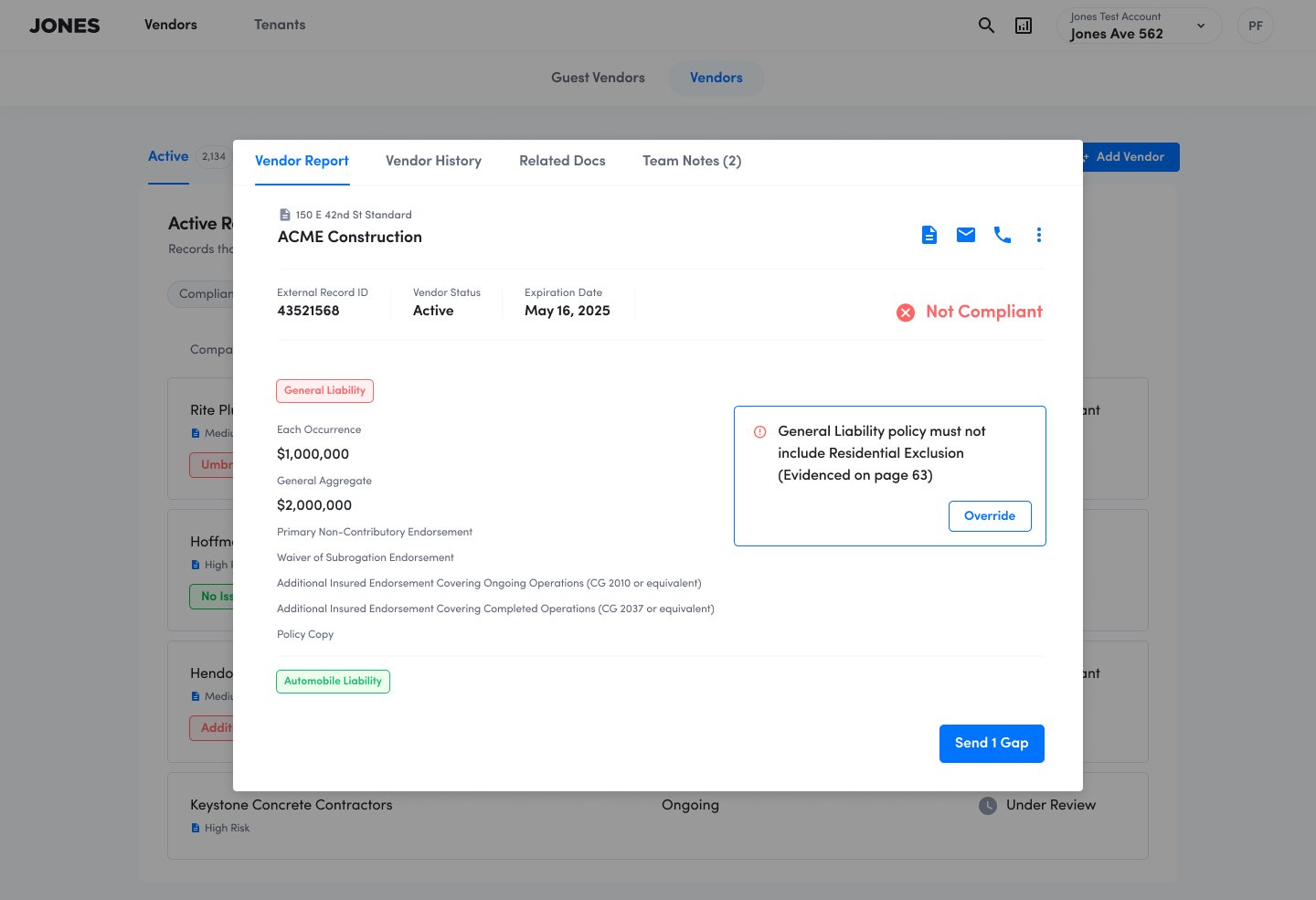
Why is a COI in Construction Critical for Compliance: Residential exclusion

Note: Ready to explore how Jones can improve your COI management process? Talk to our team of experts today!

Let’s Chat!

Why COIs Are Essential, But Not Sufficient

In a perfect world, every vendor would have a comprehensive policy tailored to your project’s needs. But in reality, insurance programs vary wildly. Some vendors work across states or trades. Others purchase cheap policies with narrow coverage to meet bid requirements.

The COI is the gatekeeper. If a subcontractor can’t provide a COI that aligns with your project’s contractual insurance requirements, they shouldn’t be on the job. That’s not legal paranoia. It’s a contractual obligation.

In fact, most construction contracts include specific insurance language, often requiring:

  • $1M/$2M+ General Liability limits
  • Commercial Auto and Umbrella/Excess coverage
  • Workers’ Compensation with statutory limits
  • Additional Insured status (CG 20 10 and CG 20 37)
  • Waiver of Subrogation
  • Primary and Non-Contributory language

These insurance requirements may differ depending on the subcontractor’s scope of work. For example, requirements such as Professional Liability or Pollution Liability only apply to subcontractors performing certain types of work.

Jones configures insurance requirements based on your company’s risk management strategy (e.g., one set of rules for Wrap subs and another for Non-Wrap subs). We will also conduct an Auditing Standards Review call to align on the review rules and how strictly your company wants to enforce compliance.

How how we customize review rules for Additional Insured:

Client 1’s rules: Checkbox in the AI column must be marked

Client 2’s rules: AI must appear on all three places:

The Description of Operations
AI Endorsement for Ongoing Operations
AI Endorsement for Completed Operations

Once the requirements and process are established, Jones will review COIs, endorsements, and insurance policies for compliance, flagging every missing detail.

Where COI Workflows Break Down

Superficial Review

Many firms rely on a basic checklist (expiration date, General Liability, and Workers’ Comp), and approve subcontractors without checking limits or endorsements. But if the named insured doesn’t match, or the endorsements are missing, the document may be meaningless during a claim or an external audit.

Jones addresses this by applying a two-level full compliance verification for all our customers. It includes OCR technology and a review by the Jones COI review experts who are trained in construction-specific policies and forms. In these blog posts, you can learn more about how we train our COI review experts and how we approach verification of endorsements.

No Review Standards

In some firms, internal teams are not fully aligned on how to interpret insurance requirements. 

Jones enforces uniformity so that your organization’s compliance standards are enforced consistently. 

No Audit Trail

Without documentation detailing who approved a COI and why, teams are left vulnerable. Verbal sign-offs and email chains don’t cut it.

Jones creates a clear, timestamped record of every COI submission, review, and approval, giving risk leaders full visibility and defensibility.

COI Compliance = Operational Discipline

A true COI compliance program isn’t about collecting paper. It’s about:

  • Complementing it with other risk transfer strategies such as full policy verification and enforcement of contract terms
  • Systematizing document review
  • Tracking and surfacing exceptions
  • Demonstrating due diligence

Jones makes this possible without adding headcount by centralizing intake, enabling fast, accurate verification for compliance, and enabling jobsite-to-backoffice visibility.

Instead of digging through emails or spreadsheets, teams can log into Jones and see which vendors are cleared, which are pending, and which are non compliant and need to provide an updated COI before being allowed to a jobsite.

How Jones Powers a Modern COI Workflow

Here’s how leading general contractors (such as Harvey-Cleary, Manhattan Construction, and others) are using Jones to upgrade their COI process:

Structured and Easy COI collection

Vendors upload their COIs to Jones without having to login. The process is frictionless to ensure that the fastest collection of insurance documents. (As of May 2025, Jones also offers a guaranteed 90% collection to customers on our Jones Operator AKA Concierge plan).

Full-Service Compliance Checks

Jones verifies every detail on subcontractors’ COIs and endorsements, including expiration dates, coverage limits, and required policy types. It flags inconsistencies, expired policies, and mismatched names. We use OCR technology and AI, but every set of insurance documents is also routed to Jones’ expert reviewers. Our SLA to review a subcontractor’s insurance is under 24 hours (although in practice it’s oftentimes under 5 hours), and our accuracy is at 99.96%.

Procore, CMiC, Sage Integrations

Jones connects directly to the tools your teams already use, so no duplicate data entry is needed. Our latest product updates include Procore Side Panel and Microsoft Outlook Copilot – these tools let you take key insurance compliance actions such as Request a COI without having to log into Jones.

Microsoft Outlook Copilot enables clients to instantly view compliance reports, gaps, and issues—all without leaving Outlook:
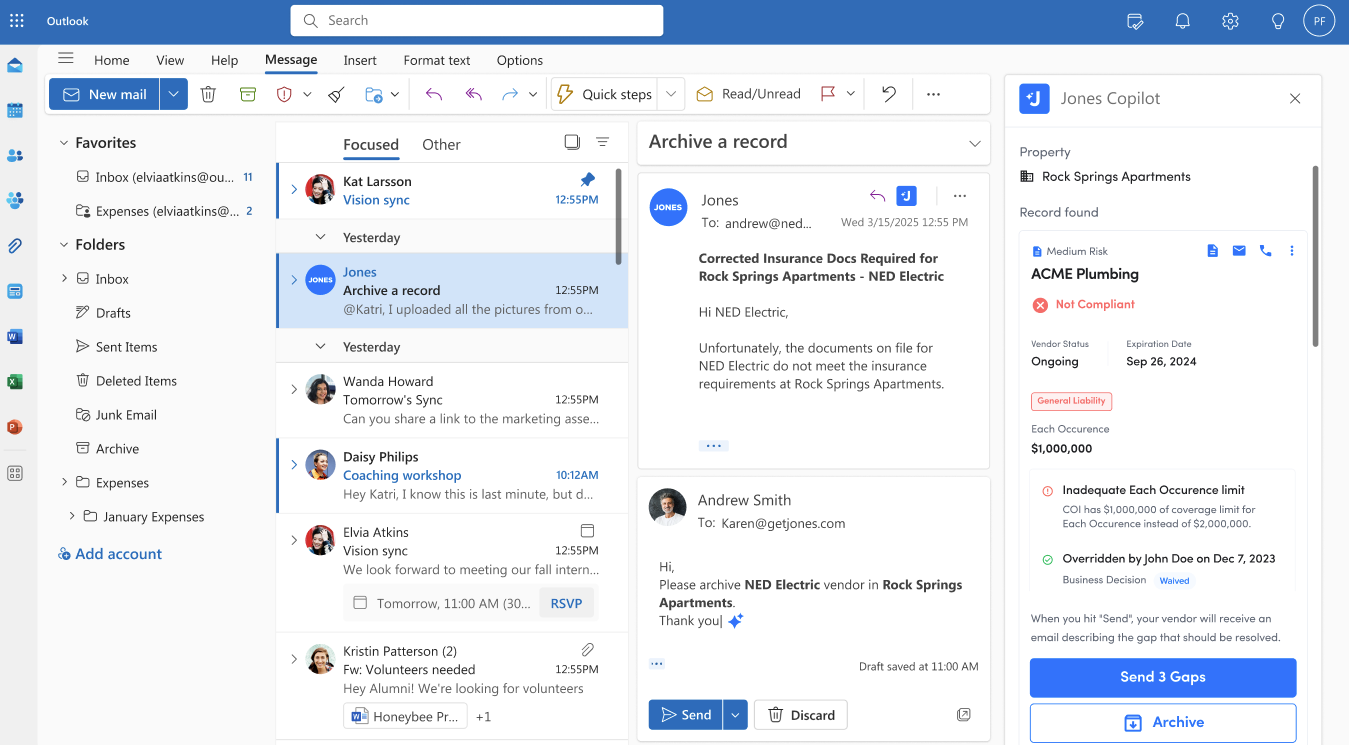
Managing COIs in Microsoft Outlook Copilot

Procore users can manage compliance via Jones Side Panel app:
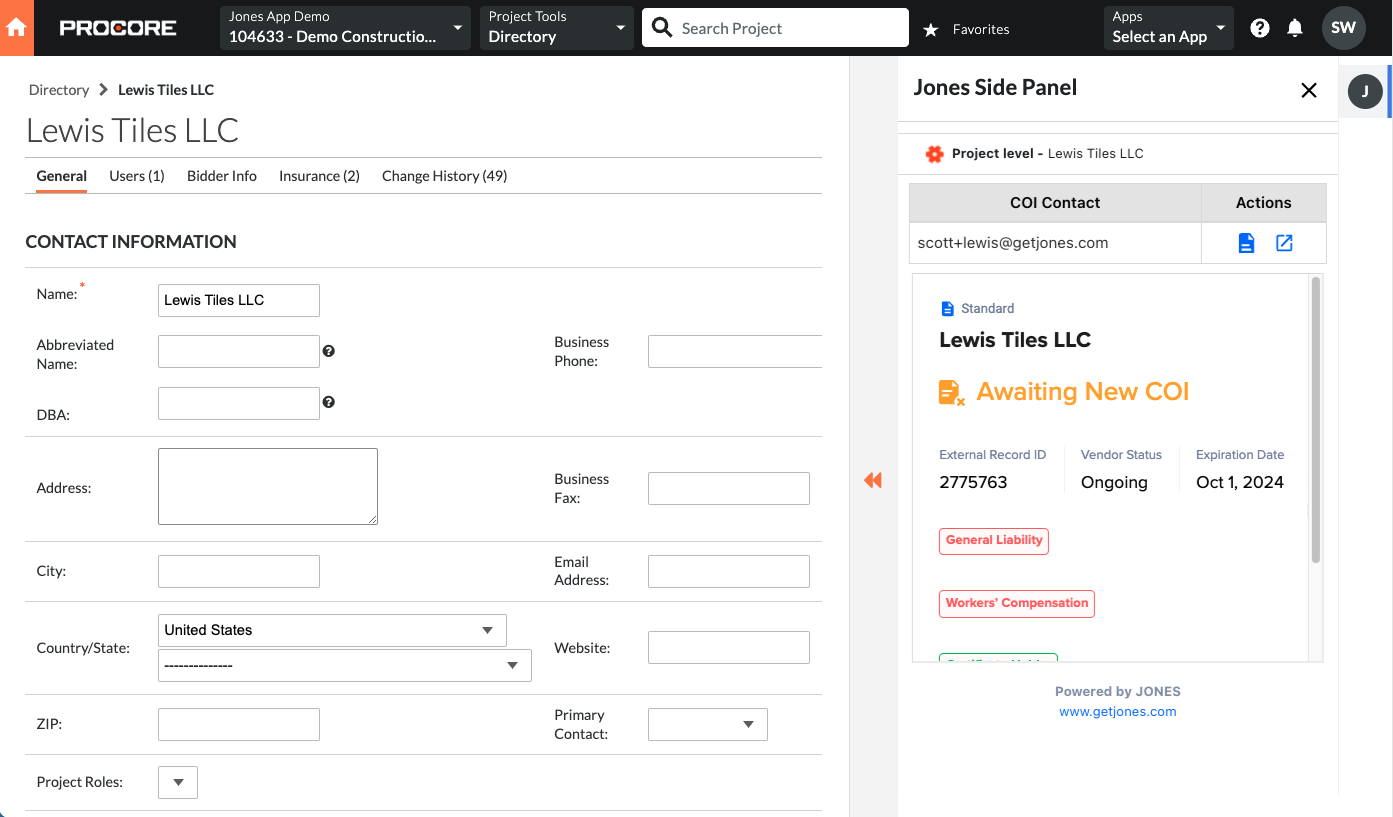
Managing COIs in the Procore Side Panel

Full Audit Logging

Every action – COI submissions, review results, waivers, and approvals – is logged, creating a bulletproof compliance trail for internal or external review.

Real-World Results from Jones Customers

Manhattan Construction sped up payments to subcontractors by a week, improved insurance compliance to 90%+, and reduced time spent on COI-related tasks by 50%.

Bogard Construction saved almost 2,000 hours a year and dramatically reduced their risk exposure thanks to Jones.

Tired of Reviewing COIs and Endorsements Manually?

Jones automates the collection and review of COIs for property management companies, owner-operators, and general contractors across the US. Reach out to us via the form below to find out more about how Jones can help your organization manage your insurance documents.
COI Verification Best Practices: Automating Risk and Compliance

COI verification

Why COI Verification Is More Than a Checklist

It’s easy to treat COI collection as a routine administrative step: gather the document, check expiration dates, and file it away. But contractual insurance requirements aren’t standardized—they’re precise, detailed, and often buried in endorsement language the COI doesn’t reflect.

Imagine a project requiring $5M in General Liability coverage with Additional Insured status and a Waiver of Subrogation. A vendor submits a COI showing $1M in coverage and makes no reference to required endorsements. Without a structured review process, this could be marked “complete,” simply because the form looks familiar.

This disconnect happens more than it should. A Jones audit in 2023 found that nearly half of submitted COIs lacked one or more key compliance elements—usually endorsements. Many of these were still being approved.

Jones solves this problem by centralizing COI intake and verification into a consistent digital workflow. Smart portals enforce naming conventions, policy type fields, and project-linked submission—all of which reduce the odds of misfiled or incomplete documents making it into your system.

What’s needed isn’t just a COI on file—it’s proof that the vendor met every documented requirement. That’s the standard contracts are written to, and the one project teams are expected to uphold.

Note: Ready to explore how Jones can streamline your COI management process? Talk to our team of experts today!

Let’s Chat!

The Hidden Costs of Manual COI Verification

Even the most organized team can’t keep pace with manual COI review at scale. Spreadsheets get stale. Folders become fragmented. Vendor emails get missed. And over time, the logic of what was accepted—and why—is lost.

In one regional construction firm, the compliance team approved a vendor based on a COI that had all the right terms—except the named insured didn’t match the contractor’s legal entity. Months later, that mismatch triggered a dispute over whether the subcontractor was actually covered.

This wasn’t an issue of risk transfer. It was an issue of compliance documentation failing to reflect contract terms.

Jones eliminates these breakdowns by replacing email-based submission with a fully auditable chain of custody. Every COI is logged with timestamps, versioning, and structured metadata—ensuring that no COI approval occurs without validation, and every decision is reviewable.

What Effective COI Verification Requires

True COI verification starts with a clear connection between what the contract requires and what’s submitted. It demands:

  • Careful confirmation that coverage types match (GL, Auto, Umbrella, WC)
  • Validation that policy limits meet stated thresholds
  • Accurate named insured review
  • Endorsement validation—especially for Additional Insured and Waivers
  • Date matching for project duration

These are not “nice to haves.” These are foundational for proving you’ve enforced your own compliance requirements.

Jones simplifies this alignment with contract-based rule engines that automatically compare submitted COIs to your insurance language. For example, if a project requires CG 20 10 and CG 20 37 endorsements, Jones can flag missing documentation or trigger a conditional rejection.


Turning Verification into a System, Not a Fire Drill

The way to avoid these errors isn’t more training or longer checklists—it’s by embedding the verification process into a repeatable, consistent system.

At Jones, COI verification is treated as a compliance operation—not a document collection task. Every submission flows through a structured intake portal, mapped to a project and vendor. Automated checks review coverage, endorsements, and policy details. Human auditors validate nuanced language and approve or reject based on your predefined standards.

This hybrid approach—technology for consistency, humans for nuance—means teams stop chasing down paperwork and start building a defensible compliance trail with every submission.

Jones’ framework includes:

  • Smart Portals: Vendors upload COIs through structured interfaces mapped to your requirements.
  • Automated Checks: Expiration dates, coverage types, and name mismatches flagged in real time.
  • Human Review: Trained compliance auditors check for required endorsements, waiver clauses, and policy gaps.
  • Audit Logs: Every decision—approval, rejection, escalation—is recorded with timestamps.

Jones also integrates with platforms like Procore, MRI Software, and CMiC—so your project teams see compliance status where they already work.

What Happens When You Systematize COI Compliance

One national GC reduced COI approval times from five days to under 24 hours without increasing staff. The change wasn’t just speed—it was structure. Vendor requirements were standardized. Review logic was enforced. Audit readiness improved.

Rather than reacting to missing documents or chasing endorsements, teams focused on enforcing standards, with Jones acting as the backbone of the process.

Real-time dashboards let compliance and operations leads see vendor status by project, division, or portfolio—making it easier to catch gaps before they become blockers.

This isn’t about transferring risk. It’s about documenting compliance consistently, visibly, and at scale.

COI Verification Isn’t Risk Management—It’s Contract Enforcement

Every COI you collect should confirm that a vendor meets the insurance terms you agreed to. If it doesn’t, you’re not in compliance.

Jones helps you operationalize that standard—automating intake, enforcing rules, validating coverage, and logging the approvals that prove you’ve done your job.

And when auditors come calling—or when a contract is challenged—you’ll have centralized, timestamped proof that every vendor met every obligation.

When compliance is systematized, the entire project benefits. Work moves faster. Fewer issues escalate. And documentation is ready when anyone asks.

See how Jones can help your team scale COI compliance with confidence. Talk to Jones

Tired of Reviewing COIs and Endorsements Manually?

Jones automates the collection and review of COIs for property management companies, owner-operators, and general contractors across the US. Reach out to us via the form below to find out more about how Jones can help your organization manage your insurance documents.

How to Manage Subcontractor Certificates of Insurance (COIs)

How to Manage Subcontractor Certificates of Insurance (COIs)

Why Subcontractor Certificates of Insurance Matter More Than Ever

In the world of construction, risk isn’t optional — it’s inevitable.

Every subcontractor on your job site is another layer of exposure: property damage, injuries, lawsuits, project delays, or worse. And when something goes wrong (because eventually it will), the very first question your risk team, owners, or legal counsel will ask is:

“Did we collect their certificate of insurance?”

Managing subcontractor certificates of insurance (COIs) isn’t just an administrative chore, it’s frontline risk management. Done right, it protects your business, your budget, and your reputation.

Done wrong? It leaves you vulnerable.

What is a Subcontractor Certificate of Insurance?

A subcontractor certificate of insurance (COI) is a one-page document that proves a subcontractor carries active insurance coverage that meets your project’s requirements.

It’s not just paperwork — it’s your first layer of protection if something goes wrong on a job site.

In construction, collecting COIs from subcontractors is essential for managing risk, avoiding liability, and staying contractually compliant.

Note: Ready to explore how Jones can streamline your COI management process? Talk to our team of experts today!

Let’s Chat!

What’s Included in a Subcontractor Certificate of Insurance?

Here’s what a typical subcontractor COI shows — and why it matters:

Named Insured

The subcontractor’s legal business name. This should match the company doing the work.

Insurance Carriers

Lists the insurance companies backing the policies. Trusted carriers (large, financially solvent corporations) reduce risk.

Coverage Types

Details active policies like:

  • General Liability — Covers bodily injury or property damage.
  • Workers’ Compensation — Covers injured employees.
  • Commercial Auto — Covers vehicles used for work.
  • Umbrella/Excess Liability — Adds extra coverage.
  • Professional Liability — For design-related services such as architects.

Policy Numbers & Limits

Unique identifiers and maximum coverage amounts. Limits must meet your contract requirements.

Effective & Expiration Dates

Shows when coverage starts and ends. Expired = no protection.

Certificate Holder

Your company name. Proves the COI was issued for your project.

Additional Insured Language

Indicates whether your company, or other important entities such as the owner are protected under the subcontractor’s policy – a key safeguard in construction.

But remember: a COI is not a contract. It’s proof of current coverage, nothing more, nothing less.

What Happens When You Don’t Manage COIs Properly?

Without properly collecting and verifying subcontractor COIs, you risk:

  • Project delays waiting on paperwork
  • Contract breaches due to non-compliant subs
  • Increased liability exposure
  • Failed audits or fines
  • Damage to client relationships
  • Financial losses if uncovered incidents occur

Bottom line: COI management is risk management. This is why modern construction teams rely on COI tracking software like Jones: to automate the process, enforce compliance, and protect every project.

Why Managing Subcontractor COIs is So Challenging

If you’re a general contractor or construction manager, you know the pain points all too well:

  • Tracking down missing COIs from dozens (or hundreds) of subcontractors
  • Manually checking policy details (and catching errors)
  • Chasing renewals to avoid coverage lapses
  • Storing COIs in inboxes or scattered folders
  • Proving compliance during audits or claims

Multiply that by every job site, every project, every subcontractor — and it’s clear why manual COI tracking breaks down fast.

Managing subcontractor COIs is messy, manual, fragmented work — especially when done at scale. It’s a constant balancing act between protecting the business and keeping projects moving forward.

The Job to Be Done: Keep Projects Moving Without Increasing Risk

Construction teams don’t get measured on how well they manage paperwork.

They get measured on getting projects done — safely, on time, and on budget.

But insurance compliance is an invisible layer of project readiness. If subs don’t have valid COIs, you’re stuck:

  • Delaying project starts
  • Scrambling to track down documents
  • Debating whether to let work proceed without proper coverage

For project managers, superintendents, and compliance teams, COI collection is one of the most frustrating bottlenecks in vendor onboarding.

The Pain: Chasing Paper Across Dozens of Vendors

Most subcontractors aren’t insurance experts. Many don’t understand the specific language you require — like Additional Insured endorsements or Waivers of Subrogation.

That means COI collection often turns into an exhausting back-and-forth:

  • “Can you send me your updated COI?”
  • “This doesn’t have the correct Additional Insured listed .”
  • “Your policy expired last week.”
  • “We still need Workers’ Comp for your crew.”

Multiply that by every subcontractor on every project — electricians, plumbers, roofers, HVAC, painters, framers, flooring installers — and it’s easy to see why risk teams are overwhelmed.

The Hidden Risks of Manual COI Tracking

Relying on email threads, spreadsheets, or paper binders might work on a small job.

But across multiple projects, this approach quickly breaks down:

  • COIs get lost in inboxes
  • Expirations sneak up unnoticed
  • Documents live in a thousand different folders
  • There’s no easy way to check compliance status in real time

Worse, when an audit or incident happens, risk teams scramble to find proof of coverage — sometimes learning only too late that a key subcontractor’s COI was expired or incomplete.

The Gain: What Modern COI Management Unlocks

This is why modern construction firms turn to COI tracking software like Jones.

It’s not just about automation — it’s about shifting COI management from a reactive fire drill into a proactive system.

With the right solution in place, risk teams can:

  • Request COIs from subs without manual email chains
  • Enforce custom insurance requirements by trade, project, or location
  • Get real-time visibility into who’s compliant (and who’s not)
  • Track expirations effortlessly with automated reminders
  • Centralize every document in one searchable dashboard
  • Onboard vendors faster without sacrificing risk controls

The Real Win: Peace of Mind at Scale

Ultimately, managing subcontractor COIs well isn’t about checking a box.

It’s about enabling your field teams to move faster — knowing the business is protected.

When COI management is done right:

  • Projects start on time
  • Risk exposure is reduced
  • Audit readiness is built-in
  • And everyone — from field ops to finance — gets back hours of time previously lost to document chasing

That’s the real gain: Operational peace of mind, even in the most complex construction environments.

What to Look for in Subcontractor COI Management Software

Modern risk management teams are turning to purpose-built software to automate the COI process.

Here’s what the best tools offer:

1. Automated COI Collection & Renewal Tracking

Request COIs from subs and send proactive reminders before expiration.

2. Custom Insurance Requirement Templates

Set unique insurance rules based on trade, job site, contract, or risk profile.

3. Real-Time Compliance Dashboards

See at a glance which subcontractors are compliant, non-compliant, or expiring soon.

4. Automated Document Review

Flag errors, missing information, or out-of-policy coverage without manual checking.

5. Self-Serve Subcontractor Portal

Make it easy for subs to upload COIs and get feedback without logins or complicated systems.

6. Centralized Document Storage

One searchable system of record for all COIs, endorsements, and contracts.

7. Audit-Ready Reporting

Instantly export reports for owners, lenders, or internal audits.

8. Integration with Construction Tools

Sync with platforms like Procore, CMiC, or your vendor management system.

Why Jones Stands Out for Subcontractor COI Management

Jones is purpose-built for modern risk teams in construction.

It’s not just about tracking documents — it’s about enabling compliance at scale without slowing down projects.

With Jones, you get:

  • Automated COI collection & renewal tracking
  • Real-time compliance dashboards
  • Customizable insurance requirements by trade
  • Seamless Procore, CMiC, Viewpoint Vista, and Sage integrations
  • Self-serve subcontractor portal (no logins required)
  • Expert document review services
  • Centralized compliance hub for all your projects

This is what operational excellence in COI management looks like.

Final Thoughts: Managing Subcontractor COIs is No Longer Optional

Construction risk is growing. Insurance requirements are getting stricter. Owners and lenders expect airtight compliance.

If you’re still tracking subcontractor certificates of insurance in spreadsheets or inboxes, it’s only a matter of time before it breaks.

Modern COI management software isn’t just a nice-to-have. It’s risk protection, project enablement, and peace of mind.

Tired of Reviewing COIs and Endorsements Manually?

Jones automates the collection and review of COIs for property management companies, owner-operators, and general contractors across the US. Reach out to us via the form below to find out more about how Jones can help your organization manage your insurance documents.