Why has B2B procurement in real estate been so slow to go digital?
Most simply, (1) hospitality has not been a core business driver for property managers and (2) they are extremely wary of liability. Of course, the risk & compliance process has existed for centuries and for good reason – to protect real estate owners from liability arising from vendors working on site. All this leaves the property manager in a precarious role – they’re not trained or incentivized to facilitate easy services that their tenants demand daily in today’s digital world. Even when vendors are finally hired for a job, the PM stands as the annoying gatekeeper with a slow, frustrating approval process to let the vendor on site.
Real estate companies hold tremendous influence over the procurement experience in buildings, which presents both great potential and great limitations. On the one hand, a vendor referral from a property manager is like currency, it comes from a trusted source and is backed by their confidence, making the decision easy. On the other hand, real estate companies do not wield this influence productively. Class A owner-operators are an example – they often curate a list of trusted, high-quality vendors for tenants. But, when a tenant selects their own preferred vendor, perhaps they are cheaper or available immediately, the compliance process is a barrier to getting the vendor through the door.
What exacerbates this problem is the fragmented nature of the vendor market, which unlike the above two challenges, is outside of a real estate company’s control. Let’s say a property manager does want to offer an easy procurement experience with a dynamic list of pre-approved vendors – good luck. The market is highly fragmented making it impossible to tap a network without acquiring each vendor locally, city-by-city. This is obviously incredibly expensive as a vast majority of real estate companies do not have the scale nor bargaining power to do so efficiently.
What if real estate companies were able to wield their influence over a much broader network of vendors instead of the limited vendor networks they own today?
The thesis is pretty straightforward – enable any property manager or tenant to tap a single digital network of vendors that are already pre-approved and that every real estate company can trust. We bring the equivalent of consumer marketplaces to the commercial real estate space.
Today, the industry is in a ripe position to unlock this opportunity riding on the wave of the tenant experience apps. Over $600M has been invested in the space enabling real estate companies to inject hospitality into their operating model, including HqO, Rise, and Lane, just to name a few who have been adopted by the “who’s who” of real estate players. The industry has picked it’s winners, however, based on a report by E&Y and CREtech “owners and operators pose the biggest ‘threat’ to start-ups and VCs, as they look to utilize or create their own concierge and community services.”
We believe that both are true. Well-funded tenant experience startups have filled the void of hospitality in real estate but owners and managers are not so quick to hand over control of the tenant experience and upside potential. The same is true for procurement – we’ve heard time-after-time from our real estate customers that leveraging vendor services for tenant retention and risk management.
So how do you scale a real estate company’s influence over a universal network of vendors?
Real estate companies should start by relinquishing control over their risk and compliance process in favor of a single system of record where any vendor that gets approved is accessible by all properties in the network. That’s what Jones is building.
In the past couple of years, Jones has discovered a contrarian truth about procurement. If you ask any real estate company who should own the risk and compliance process, they will say property managers. But the truth is the opposite – a vast majority of property managers will admit that the risk & compliance process is a nightmare and prefer to outsource it to Jones. Today, over 6,000 properties trust Jones to process tens of thousands of vendor COIs across nearly 1BN square feet of real estate every day, and our platform acts as a single source of truth for compliance data, solving the approval process end-to-end.
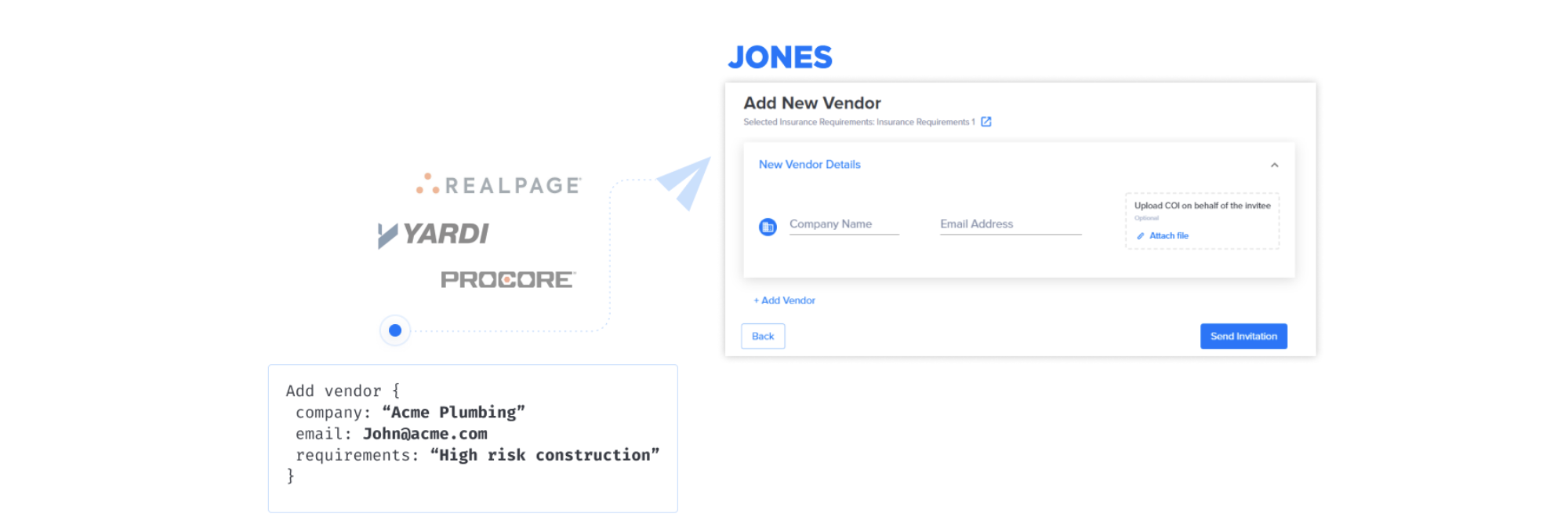
Now that we have solved risk & compliance for the CRE ecosystem, we cracked into a massive network effect by integrating all the key stakeholders – property managers, tenants and vendors – using our product every day. This gives Jones the opportunity to build a never-before-seen marketplace of trusted vendors that allows any property manager and tenant to hire any vendor for any task using easy software.
Today, we are incredibly excited to announce the next step in our journey with a Series A investment of $12.5M by JLL Spark and Khosla Ventures. Joining our Series A round are strategic players including Camber Creek, Rudin Management, DivcoWest and Sage Realty, as well as our bench of Seed investors who are doubling down. We’re super grateful for your support!